How Is a 6-to-12-Meter Frame Riveted and Flipped on the Line?
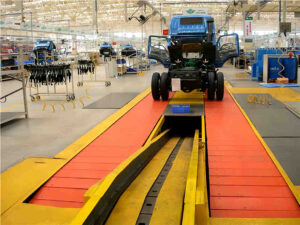
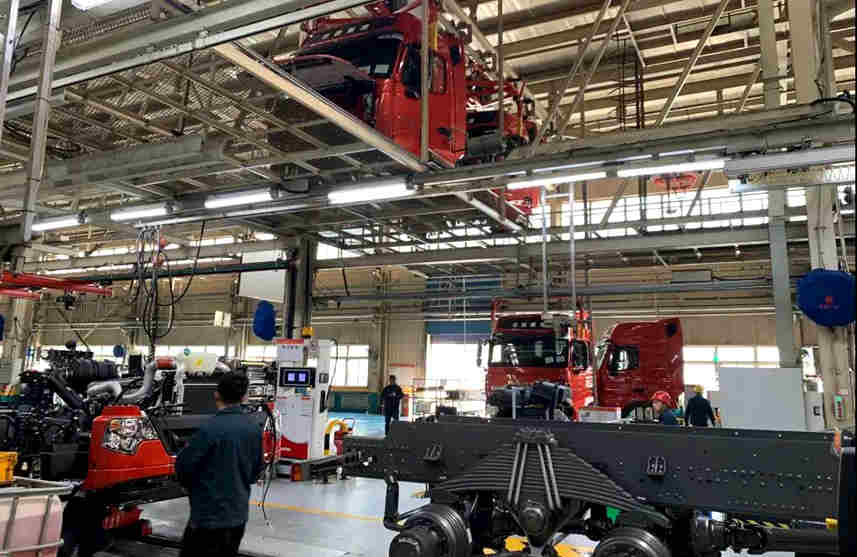
A frame 6 to 12 meters long, weighing 500 to 2000kg. Operators cannot lift or push it. A floor rail cart is the only transport method. Rated capacity: 10 tons. Hydraulic drive moves it at constant speed along the rail. No remote control needed — the operator presses a button and the cart advances to the next station.
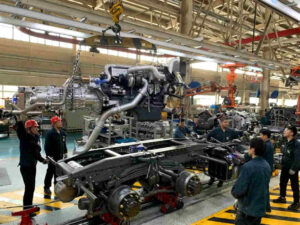
Longitudinal beams and cross members are positioned on a fixture. Hydraulic clamps lock them, and a riveter applies 200kN. Riveting force is monitored in real time — insufficient force triggers an alarm, preventing hidden defects. The cart continues to a tilting station. The frame is clamped and rotated 180°. Chassis components are installed from above in the tilted position — far easier than working under the frame on your back.
The tilting mechanism has load cells that record frame weight distribution before and after tilting. Riveting determines the line’s pace. Frame assembly and chassis component installation take approximately 30 to 60 minutes.
Medium/heavy truck monthly production is typically a few hundred to two thousand units. High-speed automation is not the priority. The line’s core value is reducing physical strain on operators.
Technical Specifications
Applicable Models: Medium and heavy-duty truck frames — frame length 6–12 metres, frame weight 500–2,000kg; applicable to both straight-frame and stepped-frame configurations; monthly production typically a few hundred to 2,000 units.
Line Layout: Floor rail cart (10-ton capacity, hydraulic drive at constant speed) transporting the frame along the line; fixture stations for longitudinal beam and cross member positioning; tilting station for 180° frame rotation; downstream chassis component installation stations (air tanks, fuel tank, battery tray, exhaust after-treatment, cab tilt mechanism).
Core Equipment: Hydraulic riveter (200kN riveting force with real-time force monitoring — insufficient force triggers an alarm preventing hidden defects); hydraulic clamps for beam positioning; tilting mechanism with integrated load cells (records frame weight distribution before and after rotation); floor rail cart with push-button station advance.
Key Technical Features: Frame is rotated 180° at the tilting station — operators install chassis components from above rather than working under the frame, dramatically reducing physical strain. Riveting force is monitored in real time — if force falls below threshold, an alarm sounds to prevent hidden rivet defects. Load cells on the tilting mechanism record frame weight distribution data before and after rotation for quality tracking. High-speed automation is not the priority; the line’s core value is reducing operator physical strain.
Production Metrics: Cycle time 30–60 minutes per unit (riveting determines the pace); monthly capacity a few hundred to 2,000 units; riveting force 200kN with real-time monitoring; frame length 6–12m; frame weight 500–2,000kg; 180° rotation for ergonomic chassis assembly.