Tens to Hundreds of Units per Year — How Does One Flexible Line Handle Dozens of Models?
Fire trucks, ambulances, military vehicles. Annual volumes range from tens to a few hundred units. Models vary dramatically. No manufacturer builds a dedicated rigid line for 50 fire trucks per year.
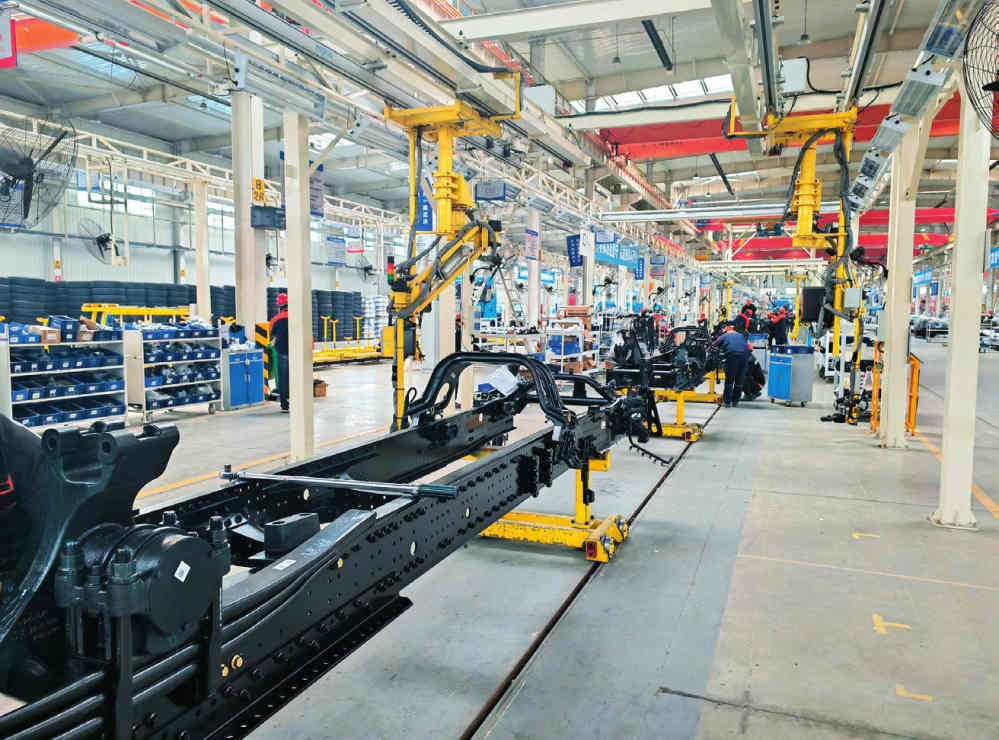
The base chassis section uses universal tooling for frame positioning and chassis assembly. The modification section is configured per project. Fire trucks get water/foam tanks, fire pumps, and light bars. Ambulances get medical compartment partitions, oxygen lines, and equipment mounts. The modular platform accepts detachable tooling — finish the fire truck batch, remove the fixtures, install ambulance brackets for the next batch.
A dedicated wiring harness station has a color-coded management system. Special vehicles have complex harnesses. One wrong wire can cause a functional failure. The multi-function test bench is equally modular: fire pump flow rate test, medical equipment insulation test, communication system integration — plug in the module for the current vehicle type.
Changeover at the modification section takes 1 to 2 days. Compared to dedicated lines, this flexible line costs approximately 30 to 50% of the investment.
Technical Specifications
Applicable Models: Fire trucks, ambulances, military vehicles, and other special-purpose vehicles — annual volumes from tens to a few hundred units per type; extreme model variety with minimal batch sizes.
Line Layout: Two-stage design — base chassis section with universal tooling for frame positioning and chassis assembly; modular modification section with detachable project-specific fixtures; colour-coded wiring harness station with standard routing template; multi-function modular test bench accepting plug-in test modules per vehicle type.
Core Equipment: Universal chassis tooling with adjustable positioning for different frame dimensions; detachable project fixtures (water/foam tank mounts, medical compartment partitions, equipment brackets); colour-coded wiring harness station with continuity test ports; modular test bench with plug-and-play modules — fire pump flow rate test, medical equipment insulation test, communication system integration.
Key Technical Features: Changeover at the modification section takes 1–2 days between vehicle types — remove the current project’s fixtures, install the next project’s mounts, and the line is ready. One wrong wire in a special vehicle can cause a functional failure, hence the colour-coded harness management system. Modular test bench accepts the appropriate module for each vehicle type without dedicated test equipment per variant. Total investment is approximately 30–50% of dedicated rigid lines for each vehicle type.
Production Metrics: Annual volume tens to hundreds of units per vehicle type; modification section changeover 1–2 days; modular modification section serves all variants; investment cost approximately 30–50% of dedicated lines; colour-coded harness management prevents wiring errors.