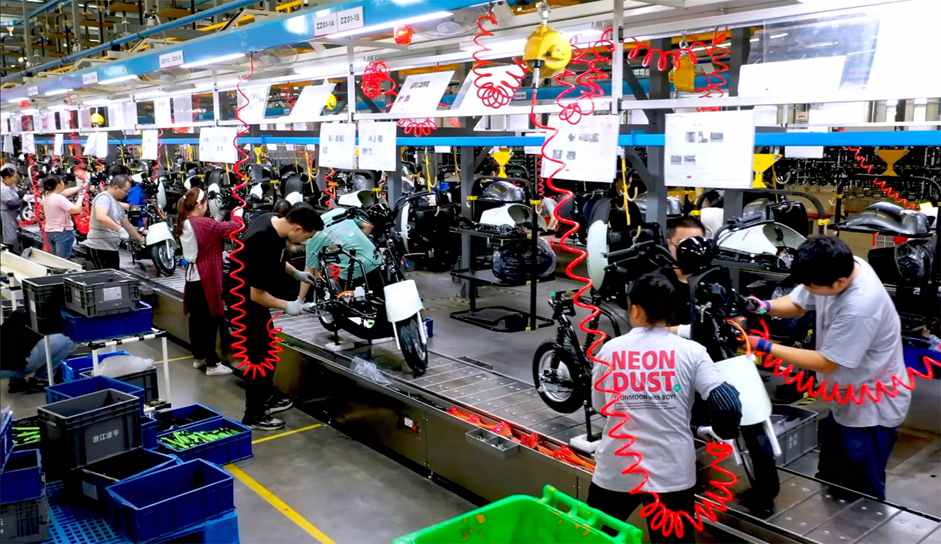
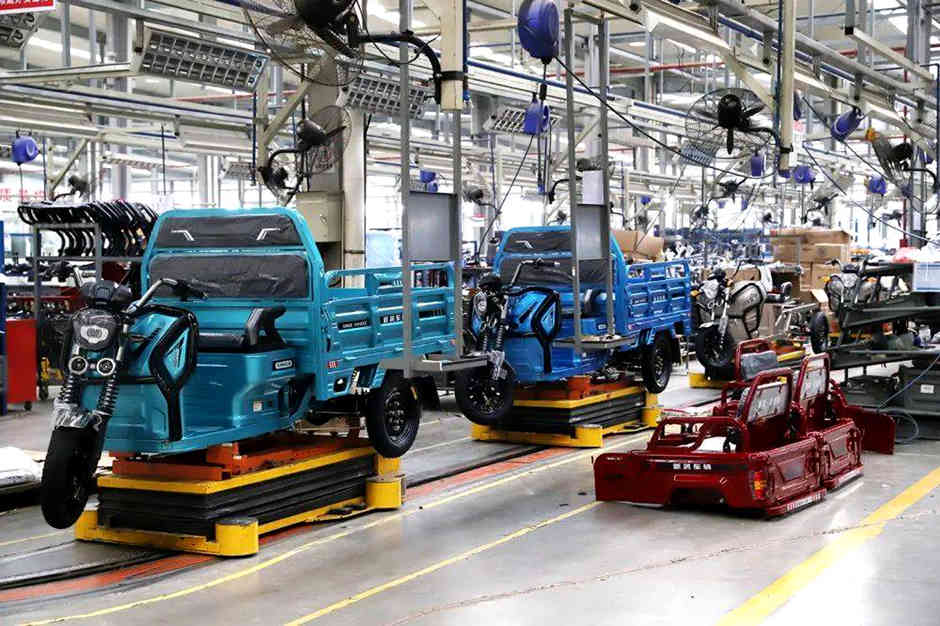
Reinforced Chain · Independent Battery Pack Marriage | 8~12 min/unit
The main difference between high-speed e-motorcycles and regular scooters is the battery pack. Lead-acid becomes lithium. Voltage jumps from 48V to 72V or even 96V. The frame needs reinforcement. Pallet capacity increases from 200kg to 500kg, with chain pitch widened to 38.1mm.
The battery pack takes an independent route: buffer storage → insulation test → marriage station. It arrives via a lift from a side buffer zone. Insulation resistance and voltage must pass before the pack enters the line. Controllers and high-voltage harnesses are installed downstream. Operators work inside orange safety barriers. An interlock system prevents entry if high voltage is still active.
A high-voltage test cabinet performs insulation testing (≥500V DC) and dielectric testing. A CAN bus diagnostic tool flashes the controller and reads parameters. Fire sprinklers are installed overhead — standard for lithium battery assembly shops.
Cycle time: 8 to 12 minutes per unit. Safety equipment accounts for roughly 15% of the total line investment.
Technical Specifications
Applicable Models: High-speed electric motorcycles (72–96V systems), high-performance delivery e-bikes, off-road e-motorcycles — lithium battery powered with high-voltage architecture; applicable to both mid-drive and hub-drive configurations.
Line Layout: Reinforced precision chain conveyor with 500kg pallet capacity (up from standard 200kg), chain pitch widened to 38.1mm; independent battery pack route — buffer storage → insulation/dielectric test → marriage station via lift; main line handles frame and chassis assembly in parallel.
Core Equipment: High-voltage test cabinet for insulation resistance (≥500V DC) and dielectric testing; CAN bus diagnostic tool for controller flashing and parameter reading; orange safety barriers with interlock system preventing entry while high voltage is active; fire sprinkler system overhead (standard for lithium battery assembly); high-voltage cable harness installation stations with dedicated tooling and torque control.
Key Technical Features: Battery pack follows an independent logistics path — tested for insulation resistance and voltage before entering the line. Rejects are intercepted at the test stage, not on the main line. Safety accounts for approximately 15% of total line investment — barriers, interlocks, HV test equipment, and sprinklers. The interlock system cuts power to the entire section if a door is opened while high voltage is active. Controller flashing via CAN bus with automatic recovery on interruption.
Production Metrics: Cycle time 8–12 minutes per unit; slower than standard two-wheeler lines due to HV safety protocols and additional testing; safety equipment ~15% of total line investment; annual capacity dependent on battery pack testing throughput.